


Football Concussion Assessment: Free Digital FIFA FOCUS
FIFA’s Football-Specific Standardised On-Pitch Concussion Assessment Protocol as a guided digital workflow. 11 domains in about 3 minutes, with every substitution trigger flagged the moment you record it. Free.
FIFA Protocol
Free
About 3 Minutes
Start On-Pitch Assessment
Free Online FIFA FOCUS
Quick signup – just name and email. All 11 FOCUS domains in FIFA’s order, on phone or tablet, with the substitution decision shown as you assess.
Free
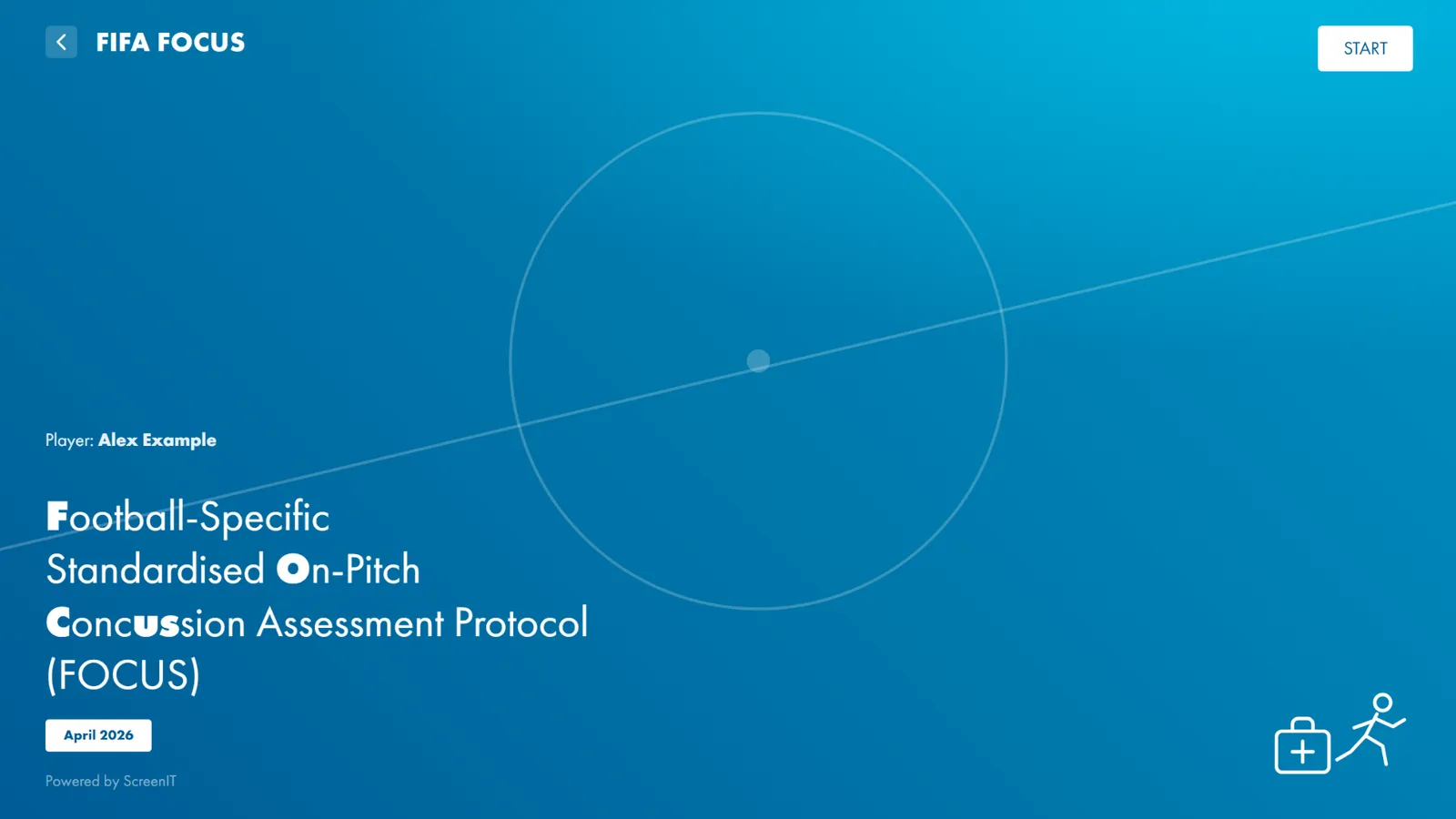
The digital FIFA FOCUS in ScreenIT: FIFA's April 2026 protocol, ready to start on phone or tablet the moment play stops.
What is FIFA FOCUS?
FIFA FOCUS is the Football-Specific Standardised On-Pitch Concussion Assessment Protocol: FIFA's standard method for assessing a football (soccer) player on the pitch after a head impact. It was developed from a comprehensive review of the scientific evidence with clinicians and researchers who work in football, and it answers one question during a stoppage in play: does this player need to be substituted for a formal concussion assessment?
Learn more about FIFA FOCUS →Why Does Football Need Its Own Concussion Protocol?
On-pitch assessments have to be quick: to limit the interruption to the match and so a stoppage cannot be used for tactical advantage. FOCUS was built for match-play, and it reflects football itself. Players often stay down or get up slowly after a head impact, so neither is a substitution trigger on its own.
What FOCUS Is Not
FOCUS is not a diagnostic tool and does not replace a thorough off-pitch clinical assessment. It identifies players who must be removed from play. Only a suspicion of concussion is needed to substitute a player, and a diagnosis is made later by a qualified practitioner.
How Does FIFA FOCUS Reach a Substitution Decision?
Every item in FOCUS carries one of three outcomes. The protocol works through visible signs, consciousness and the cervical spine first, because those decide how the player leaves the pitch.
Outcome 1
Substitute Immediately
A visible sign, anything less than Alert, a suspected neck injury, an unexplained symptom, an inappropriate answer or an abnormal balance, proprioception, eye or activity test. Further assessment and treatment happen off the pitch.
Outcome 2
Lower the Threshold
A previous concussion, an earlier head impact or assessment in the same match, anticoagulation therapy, a concerning mechanism, neck pain at rest or a blank look. The assessment continues with heightened concern.
Outcome 3
Return to Play
Only when every other item is normal does the player complete the activity-based test on the touchline. If it provokes nothing, they resume, and are monitored for delayed signs for the rest of the match.
FIFA is explicit: if you remain unsure after FOCUS, or still suspect concussion whatever the result, the player comes off. A player later found not to be concussed is the preferred outcome to a concussed player who stayed on.
What Are the 11 FIFA FOCUS Assessment Domains?
FOCUS moves from what the medical team already knows, through what can be seen from the touchline, to what the player can do. Magenta cards contain substitution triggers.
Player Medical History
Known before kick-off
Previous concussion, a concerning head impact or head injury assessment earlier in the same match, and anticoagulation therapy. Any of these lowers the threshold for concern.
Mechanism of Injury
What caused the impact
High-force mechanisms such as head-to-head, elbow-to-head, foot-to-head and head-to-ground contact, or a dual head impact, lower the threshold for concern.
Observation
Visible signs, from the touchline on
Eleven visible signs, including no protective action, tonic posturing, impact seizure, motor incoordination and vomiting, mean immediate substitution. A blank or vacant look lowers the threshold.
Level of Consciousness
ACVPU scale
Can the player recall the head impact? Only a player assessed as Alert continues. Confused, responsive only to voice or touch, or unresponsive: substitute immediately.
Cervical Spine
Rule out a serious neck injury
Neck pain at rest, midline tenderness, restricted active range of motion, unexplained limb strength or sensation changes, and numbness or tingling.
Symptoms
What the player reports
Ten symptoms, from headache or pressure in the head and dizziness to not feeling quite right. Any symptom that cannot be explained by another cause means substitution.
Orientation
Football Maddocks questions
Five questions: the venue, which half it is, who scored last, last week's opponent and last week's result. Any inappropriate answer means substitution.
Balance
Tandem stand
Eyes closed, dominant foot in front, heel to toe, for 20 seconds. Unexplained balance problems or reported dizziness mean substitution.
Proprioception
Finger to nose
With eyes closed, the player touches their nose with the left then the right index finger. The test can be repeated once.
Oculomotor Assessment
Smooth pursuit and convergence
The eyes track a target side to side, up and down, and in towards the nose, while the assessor checks for nystagmus and pupil abnormalities.
Activity-Based Assessment
On the touchline, last
Sprint 5m, turn 180 degrees left, sprint 5m, turn 180 degrees right, sprint 5m. Any sign or symptom it provokes means substitution.
Why Use a Digital FIFA FOCUS?
Three minutes on the pitch, with a referee waiting and a match to restart, is not where a checklist should depend on memory. Part of our complete assessment library.
Guided Sequence
FIFA's Order, Every Time
Each domain in the order FIFA sets out, with the fixed steps first: visible signs, level of consciousness and the cervical spine.
Live Decision
Triggers Flagged Instantly
Record a substitution trigger and the decision updates as you tap. Nothing to tally or interpret while the match waits.
Nothing Silently Missed
Reasons on the Record
An item you cannot assess asks for a reason, and a symptom explained by another cause records the explanation beside it.
Joined-Up Follow-Up
One Patient Record
The on-pitch assessment sits in the same record as the SCAT6 and SCOAT6 you use for the follow-up FIFA recommends.
Paper FOCUS
Substitution decision worked out by hand
No record of which items were checked
A skipped item leaves no reason behind
Findings written up after the final whistle
Separate from the follow-up assessment
Digital FIFA FOCUS - ScreenIT
Every domain prompted in FIFA's order
Substitution triggers flagged as you record them
Not assessed requires a reason
PDF report of the completed assessment
Same record as SCAT6 and SCOAT6 follow-up
What Happens After a FIFA FOCUS Assessment?
FOCUS decides who leaves the pitch. It is the first step in concussion care for football players, not the last.
Follow-Up Within 24-48 Hours
FIFA recommends a comprehensive clinical assessment within 24-48 hours of any head impact that needed an on-pitch assessment, whatever the FOCUS outcome, because some signs and symptoms can take up to 72 hours to appear.
SCAT6 and SCOAT6 in the Same Record
That follow-up may include the SCAT6 or SCOAT6. In ScreenIT both are free and sit in the same patient record as the FOCUS assessment, so the off-pitch clinician sees what happened on it.
When No Clinician Is Pitchside
FOCUS is for qualified medical and health care professionals. Where none is available, FIFA points to the Concussion Recognition Tool 6 (CRT6), designed for coaches, parents and other non-medical people.
Frequently Asked Questions About FIFA FOCUS
What is FIFA FOCUS?
FIFA FOCUS is the Football-Specific Standardised On-Pitch Concussion Assessment Protocol, developed by FIFA with clinicians and researchers who work in football. It gives medical staff a standard way to assess a player on the pitch after a head impact and decide whether they must be substituted for a formal concussion assessment. It covers 11 domains and takes about 3 minutes.
Who can use FIFA FOCUS?
FIFA designed FOCUS for qualified medical or health care professionals only, including doctors, physiotherapists, nurses and athletic trainers. Where no qualified professional is available, FIFA points to the Concussion Recognition Tool 6 (CRT6), which is designed for non-medical people such as coaches and parents.
How long does FIFA FOCUS take?
About 3 minutes. FIFA reports that FOCUS took approximately 3 minutes during pilot testing in a professional league. If a more serious head, neck or other injury needs managing, FIFA advises taking the time it needs and communicating clearly with the referee.
Is the digital FIFA FOCUS free?
Yes. FIFA FOCUS is one of ScreenIT’s free tools, alongside CRT6, SCAT6, SCOAT6 and SMHAT-1: unlimited assessments, no credit card and no time limit.
Does FIFA FOCUS diagnose concussion?
No. FOCUS is not a diagnostic tool and does not replace a thorough off-pitch clinical assessment. It identifies players who need to be removed from play. FIFA recommends a comprehensive clinical assessment within 24-48 hours of any head impact that needed an on-pitch assessment, whatever the FOCUS outcome, which may include the SCAT6 or SCOAT6.
What Is FIFA FOCUS Based On?
Primary Sources
FOCUS Protocol: FIFA, Football-Specific Standardised On-Pitch Concussion Assessment Protocol (April 2026)
FOCUS FAQ: FIFA Medical, FOCUS Frequently Asked Questions (July 2026)
Protocol Development: Peek et al. (2026), JAMA Neurology, doi:10.1001/jamaneurol.2026.2298
Post-Substitution Care: FIFA Concussion Protocol for Medical Staff (August 2024); FIFA Emergency Care Manual
Follow-Up Assessment: Echemendia et al. (2023), SCAT6 and SCOAT6, BJSM 57(11)
Last Reviewed
Content last reviewed: September 2026. Based on the April 2026 edition of FOCUS, which updated the December 2025 original.
Start Free Football Concussion Assessments
FIFA's on-pitch concussion assessment protocol as a guided digital workflow. 11 domains. Substitution triggers flagged as you go. Follow-up SCAT6 and SCOAT6 in the same record - completely free.
Start On-Pitch Assessment
Free Online FIFA FOCUS
All 11 domains, a live substitution decision and a PDF report.
Free
FOCUS is developed and published by FIFA. Not a diagnostic tool.